5 Proven Strategies to Elevate School Handwriting (And the Free Digital Tool Transforming Classroom Penmanship)
In an increasingly digital classroom, it can be easy to wonder: does handwriting still matter? According to cognitive neuroscientists and educational researchers, the answer is an emphatic yes. The physical act of forming letters builds critical neural pathways for reading fluency, spelling retention, spatial awareness, and working memory. Yet, primary teachers, literacy leads, and SEN coordinators consistently report that teaching neat, fluent penmanship remains one of the trickiest everyday classroom challenges.
Between managing varied fine motor control levels, supporting pupils with dysgraphia or English as an additional language (EAL), and finding time to continuously model correct stroke formation on the board, handwriting instruction can quickly feel repetitive and time-consuming.
Fortunately, modern pedagogical insights combined with smart EdTech innovations are making penmanship practice more engaging and efficient than ever. Here are 5 evidence-based strategies to improve handwriting across your school—and how to seamlessly integrate digital modeling to boost pupil outcomes.
1. Prioritise Visual "Process" Over Static "Product"
When children copy static letters from a printed sheet or poster, they often guess the starting point and stroke direction. This leads to inefficient habits, such as starting letters from the baseline or forming circles clockwise, which ultimately hinders handwriting speed and joined cursive fluency in Key Stage 2.
The Solution: Children need to see letter formation in motion. Visualizing the directional flow—where to start, lift, and loop—is crucial.
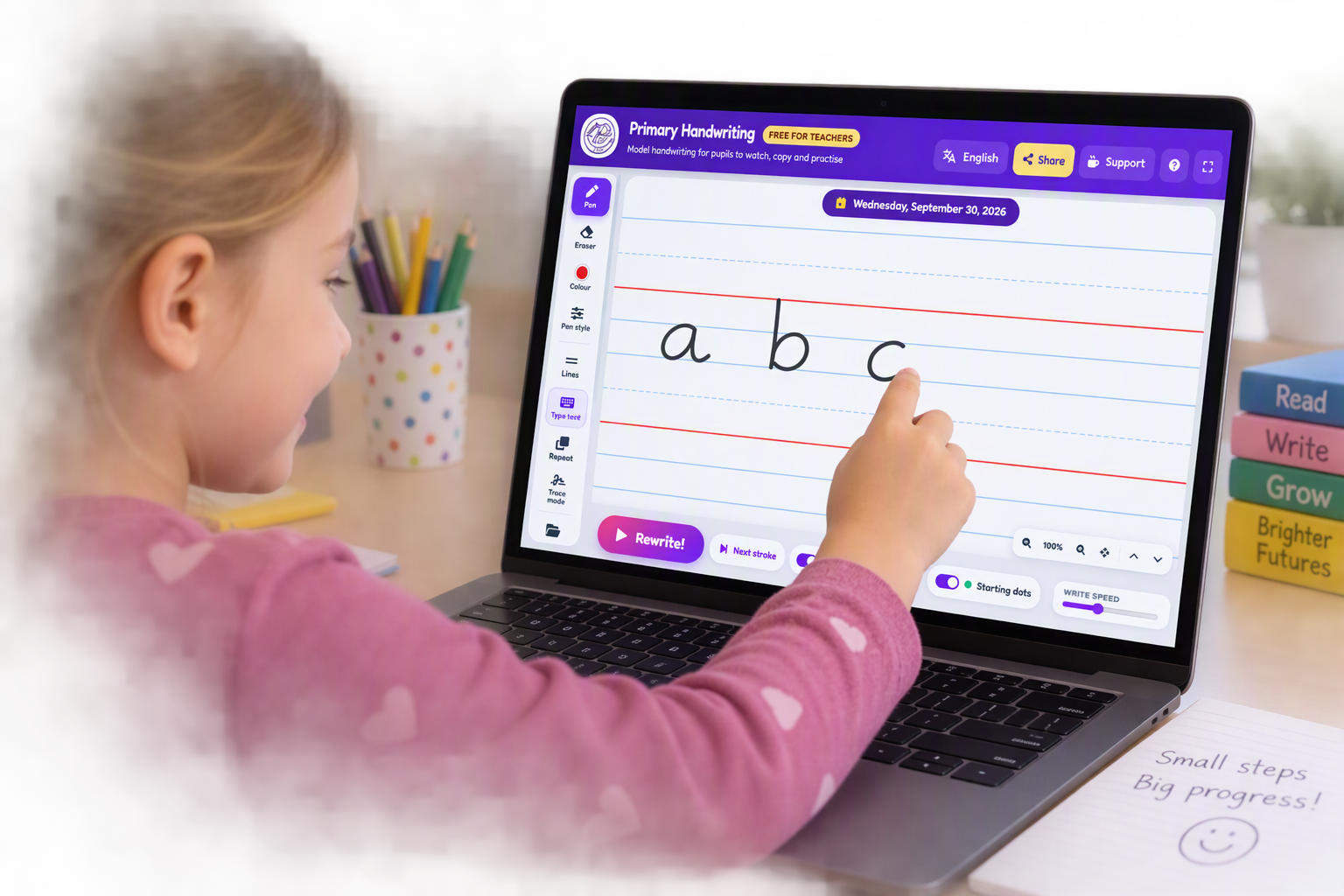
By using dynamic tools like Primary Handwriting, teachers can model a letter or common join once on their interactive display and hit "Rewrite!". The tool instantly replays the precise stroke animation on a loop, allowing pupils to observe the movement over and over while practicing at their desks.
2. Implement Key-Stage-Appropriate Guidelines
Using standard single-lined paper too early can frustrate young writers who are still mastering letter proportions, ascenders (like b, d, h), and descenders (like g, p, y).
EYFS & Early Key Stage 1: Focus on extra-large 4-line guide systems or visual color-coded baselines that delineate x-height from ascender/descender space.
Late Key Stage 1 & Key Stage 2: Transition to smaller line heights while maintaining consistency across literacy books, spelling sheets, and handwriting workbooks.
Teacher Hack: Rather than purchasing dozens of specialized exercise books, you can use a free interactive handwriting whiteboard to instantly switch background line styles on screen—from EYFS extra-large guidelines to KS2 medium lines, maths grids, and French Seyes ruling.
3. Master Common Letter Joins Early
Rather than teaching isolated letters until Key Stage 2, introducing high-frequency letter pairings (digraphs and common joins) early builds muscle memory for continuous cursive writing.
Focus on targeted join groups:
Horizontal Top Joins: co, ca, os, wi, ve
Bottom/Base Joins: in, im, un, am, ig
Tricky r-Joins: br, cr, dr, fr, gr, pr, tr
Using www.primaryhandwriting.com, educators can quickly generate faint grey tracing guides on screen for any letter pair, word list, or phonics phase, letting students trace or copy with clear visual boundaries.
4. Differentiate for SEN, Fine Motor, and Multilingual Learners
Handwriting instruction isn't one-size-fits-all. Children with fine motor delays, occupational therapy needs, or dysgraphia often require high-contrast guidelines, slower playback speeds, or specialized handwriting fonts (such as pre-cursive continuous print).
Furthermore, in multilingual or international classrooms, modeling letter variations across different regional standards can be challenging. Leveraging an adaptable tool like Primary Handwriting allows teachers to:
Adjust stroke animation speeds to accommodate slower visual processors.
Switch between dark chalkboard mode (low glare) and warm cream backgrounds for visual sensitivity.
Type custom vocabulary or sentences in any language or character script.
5. Eliminate Board-Writing Fatigue with Digital Automation
One of the biggest hurdles for teachers is physical distraction: standing with your back turned to write sentences on the board repeatedly during phonics, spelling, or daily morning work.
Modern primary classrooms are shifting toward automated board modeling. With Primary Handwriting's free tool, you can write a sentence once—or load built-in primary passages, pangrams, and A-Z sets—and set it to loop continuously while you move around the room to give targeted feedback to pupils who need extra support.
Transforming Classroom Handwriting, One Lesson at a Time
Improving handwriting across a primary school doesn't require complex curriculums or expensive software packages. By combining clear visual modeling, consistent guidelines, and smart digital looping tools, educators can build confident, fluent writers in every year group.
Ready to upgrade your handwriting lessons? Try the free Primary Handwriting interactive whiteboard tool today at www.primaryhandwriting.com and discover how effortless handwriting instruction can be.
Developed by iG Education Limited — "Improving Handwriting One Class at a Time."