Historical Perspectives, Teacher Modelling, and the Digital Future of Handwriting Instruction
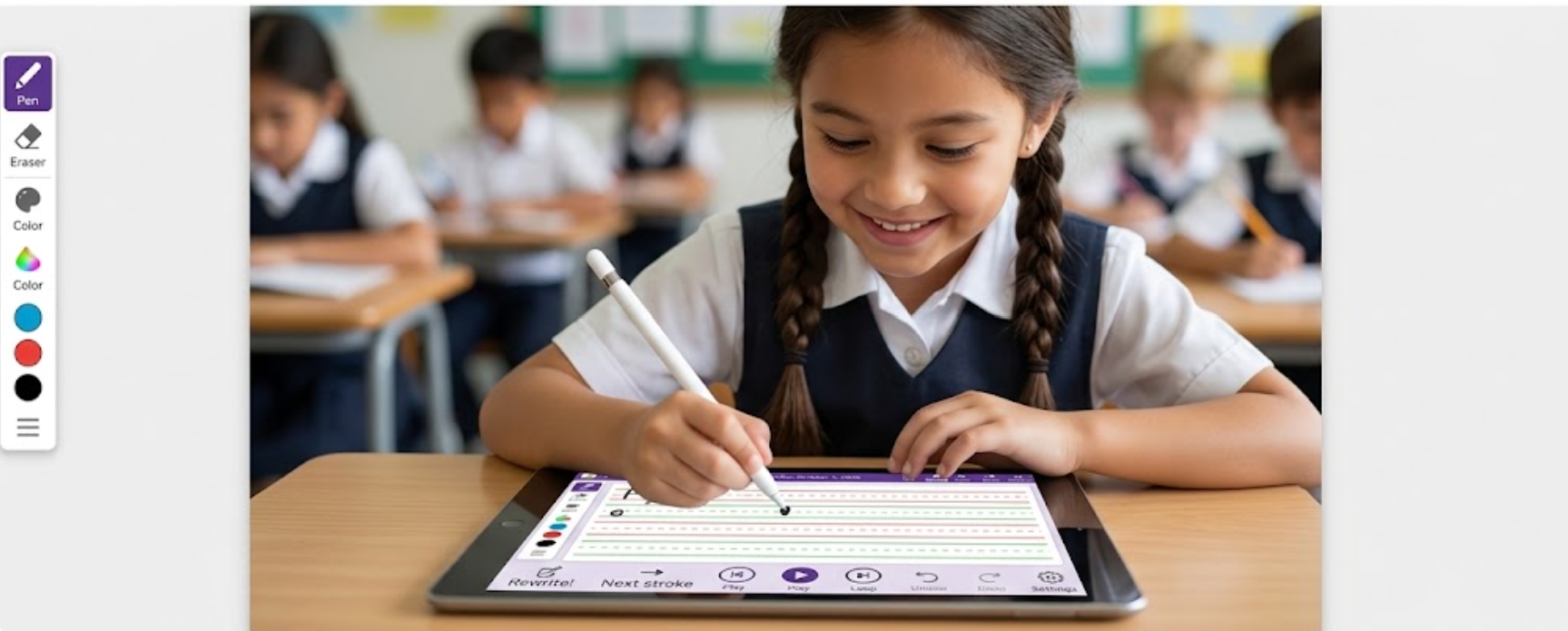
For over a century, the role of handwriting in primary education has occupied a contentious position within educational research, curriculum design, and pedagogical theory. Once viewed as the foundational pillar of formal schooling, penmanship was historically treated as a measure of character, discipline, and scholarly rigor. However, as educational paradigms shifted throughout the twentieth and early twenty-first centuries, the methods used to teach handwriting underwent significant transformations. From the rigid drills of Spencerian and Palmer script to the progressive minimalism of informal manuscript writing, educators have repeatedly re-evaluated how children acquire graphomotor fluency. In contemporary discourse, cognitive science has firmly re-established handwriting as a critical cognitive gateway to literacy rather than a mere mechanical exercise. Yet, despite this academic consensus, primary school teachers face unprecedented challenges in delivering explicit, high-quality handwriting instruction within tightly constrained timetables. Examining the historical trajectory of handwriting pedagogy reveals that the key to raising standards lies not in passive tracing or static worksheets, but in dynamic teacher modelling. Today, digital innovations such as PrimaryHandwriting.com offer a bridge between sound pedagogical principles and practical classroom implementation, maximizing instructional impact while optimizing teacher workload.
https://primaryhandwriting.comThe Evolution of Handwriting Instruction: From Rote Copybooks to Motor Cognition
To understand current challenges in handwriting attainment, one must first examine the historical shifts that shaped classroom practice. In the late nineteenth and early twentieth centuries, handwriting instruction was dominated by rigid, highly standardized copperplate and script systems. Methods such as the Palmer Method in North America and civil service hand styles in the United Kingdom emphasized physical discipline, uniform letter inclination, and endless rhythmic drills. Pupils spent hours reproducing identical letterforms from engraver-produced copybooks. While this approach produced remarkable aesthetic consistency among successful students, its underlying philosophy was steeped in behaviourist repetition. It paid little attention to individual motor development, ergonomic variance, or the underlying cognitive mechanisms of writing.
By the mid-twentieth century, the rise of progressive educational theories led to a sharp reaction against mechanical drills. Many educational authorities introduced print or unjoined manuscript lettering as an initial stage, postponing joined cursive until later primary years. The rationale was logical: print characters closely mirrored the typography found in early reading primers, thereby reducing the cognitive load on early readers. However, this shift often came at the expense of explicit graphomotor instruction. In many classrooms, handwriting was demoted from a distinct, explicitly taught discipline to an incidental skill that children were expected to absorb organically through general composition tasks.
By the late twentieth and early twenty-first centuries, the widespread adoption of desktop publishing and personal computing led to a prevalent, albeit mistaken, belief that digital keyboards would render manual handwriting obsolete. Consequently, explicit instructional time for handwriting declined across many primary curricula.
Recent cognitive neuroscience and educational psychology have thoroughly debunked the notion that handwriting is an obsolete artifact. Research by cognitive scientists such as Virginia Berninger and Steve Graham has demonstrated that handwriting is intimately linked to reading development, spelling accuracy, and written composition quality. Writing by hand engages complex neuro-motor pathways that reinforce letter recognition and phonological awareness in ways that typing on a keyboard simply cannot replicate.
Furthermore, Sweller’s Cognitive Load Theory provides a compelling framework for understanding the necessity of fluent handwriting. When a pupil has not automated the physical production of letterforms, their working memory is burdened by the lower-order mechanics of pen control, baseline placement, and stroke directionality. As a result, cognitive capacity is drained away from higher-order compositional processes, such as vocabulary selection, sentence structuring, and narrative cohesion. Automaticity in handwriting is therefore not a decorative luxury; it is a prerequisite for cognitive liberation in written expression.
The Primacy of Teacher Modelling and the Cognitive Architecture of Motor Skills
Despite the unequivocal research highlighting the importance of handwriting automaticity, the question of how best to cultivate it in young learners remains central to pedagogical debates. Historically, many primary classrooms relied heavily on commercial workbooks and pre-printed tracing sheets. While these resources provide quiet desk work, academic evaluation of graphomotor acquisition demonstrates that passive tracing is among the least effective methods for establishing long-term motor memory.
When a child traces over a static dotted letter, their visual focus is confined to keeping the pen tip within narrow guidelines. This encourages a hesitant, slow, point-to-point drawing motion rather than a fluid, continuous motor movement. Tracing shows the child the final spatial artifact, but it fails to communicate the dynamic temporal process of letter formation: the vector, line velocity, start point, stroke sequence, pen lifts, and rhythmic flow.
Observational learning theory, pioneered by Albert Bandura, alongside contemporary research into motor skill acquisition, emphasizes that children learn complex physical movements most effectively through active, explicit teacher modelling. When a teacher explicitly models handwriting, pupils observe a live motor demonstration. They observe the correct pencil grip, posture, paper orientation, start point, stroke direction, proportion, and join technique in real time.
Crucially, effective modelling is dual-coded: the teacher pairs the visual demonstration with explicit verbal narration—often referred to as handwriting 'patter' or verbal cues (for example, "start at the top line, curve down around the clock, and lift"). This verbalization helps pupils internalize a cognitive schema of the letterform, guiding their own motor execution when they transition to independent practice.
However, translating live teacher modelling into daily classroom reality presents substantial practical hurdles. Historically, teachers modelled handwriting on a vertical blackboard or whiteboard. While vertical modelling offers a shared visual focus for the entire class, it suffers from an ergonomic disconnect: writing on a vertical surface using gross motor movements of the arm does not mirror the fine motor control required for horizontal desk-based writing with a pen or pencil.
Furthermore, vertical whiteboard writing frequently leads to distortions in letter proportion and angle. To mitigate this, teachers have traditionally attempted to produce individual handwritten target strips or manually written exemplars in every pupil’s exercise book. While highly effective, this manual preparation is immensely time-consuming, placing an unsustainable burden on teacher planning and preparation hours. In an era where educator burnout and workload pressures are critical retention issues, schools urgently require innovative solutions that preserve the pedagogical power of teacher modelling without demanding hours of manual labour.
Bridging Pedagogy and Workload: PrimaryHandwriting.com as a Modern Instructional Catalyst
It is precisely at this intersection of pedagogical rigour and instructional efficiency that modern educational technology can transform classroom practice. Platforms such as PrimaryHandwriting.com have been explicitly engineered to address the historical limitations of handwriting instruction, placing authentic teacher modelling at the heart of the digital workflow while dramatically streamlining teacher preparation time.
PrimaryHandwriting.com recognizes that generic, computerized fonts often fail to capture the nuances of a school’s specific handwriting policy or a teacher’s personal instructional style. Rather than forcing classes to adapt to rigid, pre-packaged digital scripts, the platform enables teachers to model and generate customized, authentic handwriting assets that reflect exact institutional guidelines—whether teaching unjoined manuscript, continuous cursive, or transitional joined styles. By digitizing the teacher’s own modelling, the platform transforms a ephemeral whiteboard demonstration into a reusable, high-definition instructional asset.
For whole-class tuition, PrimaryHandwriting.com integrates seamlessly into interactive whiteboards and classroom displays. Teachers can project dynamic, high-resolution stroke animations and live-rendered script exemplars onto lined grid backgrounds that perfectly mirror the exercise books sitting on pupils' desks. This eliminates the spatial and ergonomic distortion traditional vertical board writing created. During whole-class instruction, the teacher can play, pause, loop, and step through stroke formations, allowing them to circulate around the classroom, assess pencil grips, provide instant feedback, and scaffold support for struggling pupils while the digital model continues to display perfect letter directionality and spatial proportions.
Moreover, the platform directly addresses the realities of modern hybrid and digital learning environments by integrating seamlessly with platforms like Google Classroom. Teachers can post video demonstrations, digital practice templates, and tailored instructional guides directly to pupil streams. This digital connectivity ensures that absent pupils, early years learners requiring home reinforcement, or pupils with specific neurodiverse needs (such as dysgraphia or fine motor delays) can access high-quality, repeatable teacher models outside the physical classroom. A child struggling with diagonal letter joins can rewatch their teacher’s explicit formation video on Google Classroom at their own pace, bridging the gap between school instruction and home practice.
From a workload perspective, the efficiency gains provided by PrimaryHandwriting.com represent a substantial shift in resource management. Rather than spending hours drawing guidelines or handwriting individual target lines across dozens of books, teachers can generate differentiated, perfectly aligned handwriting sheets and digital exercise templates in a matter of minutes. Worksheets can be customized to incorporate current phonics patterns, weekly spelling lists, or cross-curricular subject vocabulary, effectively embedding handwriting practice within broader literacy and humanities contexts.
In summary, the history of handwriting pedagogy demonstrates that mechanical copybook drills and passive tracing sheets are insufficient for cultivating true graphomotor fluency. Children require explicit, dynamic, dual-coded teacher modelling to build the motor memory necessary for automatic handwriting. By harnessing the capabilities of PrimaryHandwriting.com, primary educators can deliver rigorous, standardized, and engaging handwriting instruction across whole-class and digital platforms like Google Classroom. In doing so, schools can raise standards in pupil presentation, spelling, and compositional confidence, all while honouring and protecting the valuable time of classroom teachers.